

The Hidden Self-Preservation Behind the UK’s Blue Investments in the Philippines
OLYMPUS CORPORATION, TG-5Free to use under the Unsplash License
We, without a doubt, live in a time in which the climate catastrophe is awaiting us at the end of a ticking bomb that seems to tick faster and faster every passing day. And it seems that nothing, no climate conferences, no international climate pacts, no amount of renewable energies or taxes on non-renewable energies, will soon compensate for, or even simply stabilise, the damage already done.
What is now emerging as a new beacon of hope is Blue Carbon and Green Investment.
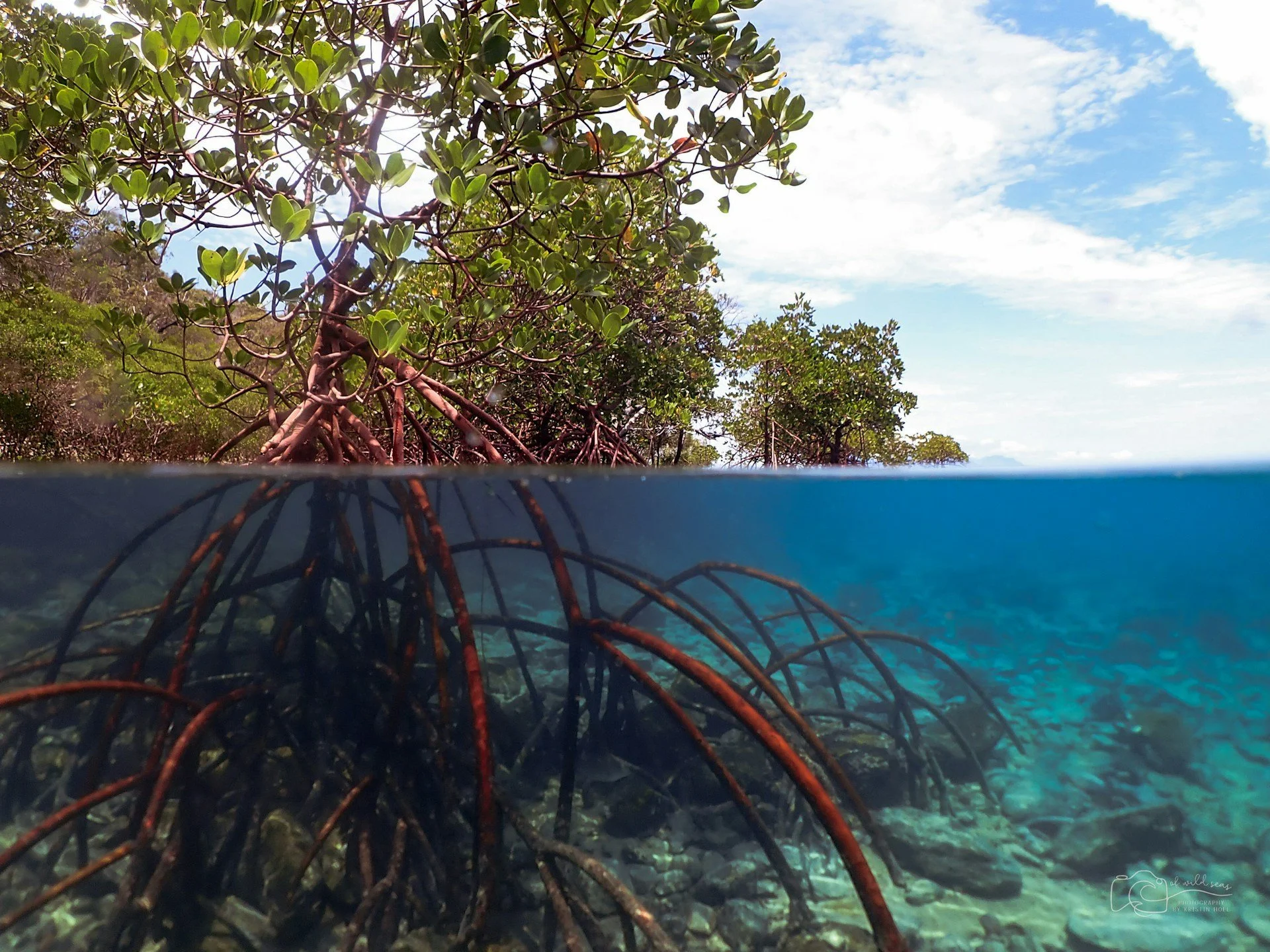
Blue Investment falls under the umbrella of Green Investment and describes expenditures in coastal marine landscapes through the planting of mangrove trees, coral reefs, seaweed meadows, and multiple other measures. Not only do such measures increase biodiversity and fight the consequences of climate change, such as the more probable outbreak of specific diseases, extreme heatwaves, and the jeopardisation of shorelines through storms and floods, but they can also tackle climate change much more directly through Blue Carbon.[1] Blue Carbon describes the accumulation of more than 90 per cent of the excess heat and CO2 from the atmosphere in the ocean, whilst at the same time, generating about half the oxygen in the air.[2] The investment in sustaining and reintroducing diverse coastal and marine plants, therefore, can be seen as a direct countermeasure against the progressing global climate change. The more emissions bound in Blue Carbon, the more biodiversity and local food security can be ensured, which has a direct impact on the protection of the global agrifood chains.[3]
As for now, Blue Investment might sound like a project that could be a solution to finally tackle the climate catastrophe and bring countries together in a common attempt to work on rebuilding spaces hit worst by climate destruction and strive for significant co-benefits. The United Kingdom and the Philippines, as an example, started an extensive Blue Investment program that is mostly financed by the UK government, the Zoological Society London, and big conglomerates in the Philippines.[4] But what comes to mind when considering that Blue Investment in the Philippines is mostly sponsored by the UK, responsible for more than double the percentage of the annual global CO2 emissions than the Philippines. Considering the locations of these financial activities, what does that tell us about the hidden intentions, interests, and power dynamics of Blue Investment?
The greatest concern about Blue Investments in ecologically diverse developing countries, such as the Philippines, is the commercial aspect of it. Investments in carbon sinks such as Blue Carbon, on one side, can help save money usually lost due to extreme weather events on the other side. In 2025, the UK recorded more than £800m in lost production in the agricultural sector because of extreme weather, while the absorption of emissions in European carbon sinks has been continuously declining, threatening Europe’s climate goals.[5] So, investing in carbon sinks abroad can be an attractive temporary solution for counter measuring climate change. Through binding emissions, mangrove carbon sinks provide around 2.7 trillion US dollars in services and 194,000 US dollars per hectare annually.[6] Mangrove forests, therefore, become more than a ‘simple’ ecological barrier between men and sea or a space of biodiversity – they become assets.
Another aspect that illustrates the shift from nature to capital is the West’s interest in sustaining local and global food chains through Blue Investment. Climate change has a drastic effect on crops, fruits, and all other kinds of agrifoods worldwide – in the UK as much as in the Philippines – through longer and harsher periods of rain and drought, as well as the establishment of environments that facilitate the spread and persistence of crop-harming pests. This increases the need for expensive pesticides and makes exports and imports more bureaucratically challenging, resulting in fewer food products for both the local people and the international market.
Take Mangoes for example. They are not only a sweet treat, but they are also an important economic commodity. Mangoes can make between 1000 and 1500 US dollars per tonne in exports and are one of the most important export products in the Philippines.[7] Now, through climate change and its consequences, there is not only a significant shortage of and increased prices for mangoes in the Philippines, but also in the rest of the world. Such a shortage of arguably more luxurious products, similar to coffee, tea, or other fruits, and most often caused by increased needs for pesticides and higher general costs for the farmers, might not be fatal for the West, but definitely uncomfortable. And although such products build only the end of such a food chain and food supply to the West, they are a good example of what could await much more basic and substantial foods with the progress of climate change.
Participating in Blue Investment, therefore, helps prevent the progress of climate change to sustain the current quality of life, which, again, accelerates climate change. It is a vicious circle. And, most importantly, it shows the true character of such projects as Blue Investment: under the veil of benefitting all, it really benefits only those who have the means of investing in it, aka companies, conglomerates, and wealthy countries.[8] It is like building a fortress just to break it down even before its full completion. Although Blue Investment surely has some positive influences on local communities and ecosystems where Blue Carbon projects are implemented, they only tackle climate change to some extent, which will probably not keep up with the progress of environmentally damaging economies. Blue Investment is inextricably tied to business and economy and, therefore, equally inextricably tied to modes of consumption that dismantle what Blue Investment stands for – biodiversity, stability, and cooperation.
The unfairness of Blue Investments not only becomes apparent in the hidden, ongoing destruction of regions and countries most vulnerable to the consequences of climate change, but also in the so-called debt-for-nature swaps under which most Blue Investment projects operate. Debt-for-nature swaps describe how countries from the Global South with valuable or endangered natural resources or ecosystems and with great sums of accumulated foreign debts (which usually are consequences of either colonialism or foreign mismanagement of “development strategies” in those countries) can “swap” these through a greater engagement with and protection of their natural spaces. Though this approach is supposed to benefit the debtor country, as it, in theory, is not driven by a profit motive, it turns it more precarious to foreign interests and motives.
When natural reserves and wide stretches of forests and land are bought and managed by large international institutions or NGOs, how can one guarantee that local needs are matched and voices heard? If local communities in the Philippines are being “rewarded” for sustaining the new mangrove forests that so much money was pumped into,[9] can they also be punished for using these natural spaces in ways that go against institutional imaginations of nature and nature conservation? Not only are local communities in regions where Blue Investment takes place vulnerable to the consequences of climate change, but they also become vulnerable to the Western ways of managing foreign land in an almost (or very much) colonial fashion that might collide with their needs for resource extraction or the establishment of settlements and other infrastructures.[10] In the end, debt-to-nature swaps not only reinforce the historically unfair indebtedness of Global South countries like the Philippines, but they actively continue the legacy.
In the end, the good intentions of Blue Investment are undeniable, and the possible positive effects of it, for both local and global communities and natural environments, should not be underestimated. However, looking behind the cover of natural protection and conservation, the patterns of power, knowledge production and implementation are equally undeniable parts of Blue Investment and rightfully raise questions about the sustainability, fairness, and ethics of such investment projects. Can this project ever be truly successful in a world in which Western countries continue to strive for immeasurable economic growth, whilst other countries in the Global South face the consequences of such ambitions? To what extent is this all just a show?
[1] https://www.lse.ac.uk/granthaminstitute/news/scaling-up-investments-in-mangrove-livelihoods-for-healthy-people-and-the-planet/
https://www.lse.ac.uk/granthaminstitute/projects/blufinplan/financing-the-blue-economy-blufinplan-research-projects-and-team-country-expertise/
https://www.weforum.org/friends-of-ocean-action/the-philippines-kicks-off-pioneering-national-blue-carbon-action-partnership/
https://www.lse.ac.uk/granthaminstitute/regulating-and-cultural-services-of-mangroves/
[2] https://doi.org/10.1136/bmj.r2635
[3] https://www.lse.ac.uk/granthaminstitute/news/why-engaging-with-food-insecurity-in-the-context-of-climate-change-is-increasingly-important/
[4] https://www.lse.ac.uk/granthaminstitute/news/philippines-research-project-receives-british-academy-funding/
https://www.weforum.org/friends-of-ocean-action/the-philippines-kicks-off-pioneering-national-blue-carbon-action-partnership/
[5] https://www.theguardian.com/environment/2025/dec/04/record-heat-drought-2025-cost-uk-arable-farmers-estimated-800m-climate-crisis-grain-harvest
https://joint-research-centre.ec.europa.eu/jrc-news-and-updates/european-forest-carbon-sink-declining-can-we-reverse-trend-2025-07-30_en
[6] https://www.lse.ac.uk/granthaminstitute/news/scaling-up-investments-in-mangrove-livelihoods-for-healthy-people-and-the-planet/
[7] https://www.khmertimeskh.com/50732485/mango-exports-to-sell-at-1000-to-1500-per-tonne/
[8] https://www.weforum.org/friends-of-ocean-action/the-philippines-kicks-off-pioneering-national-blue-carbon-action-partnership/
[9] https://www.lse.ac.uk/granthaminstitute/news/scaling-up-investments-in-mangrove-livelihoods-for-healthy-people-and-the-planet/
[10] https://www.carbonbrief.org/qa-can-debt-for-nature-swaps-help-tackle-biodiversity-loss-and-climate-change/
