

Growing Old in a Changing Hong Kong: Enjoyment or Challenge?
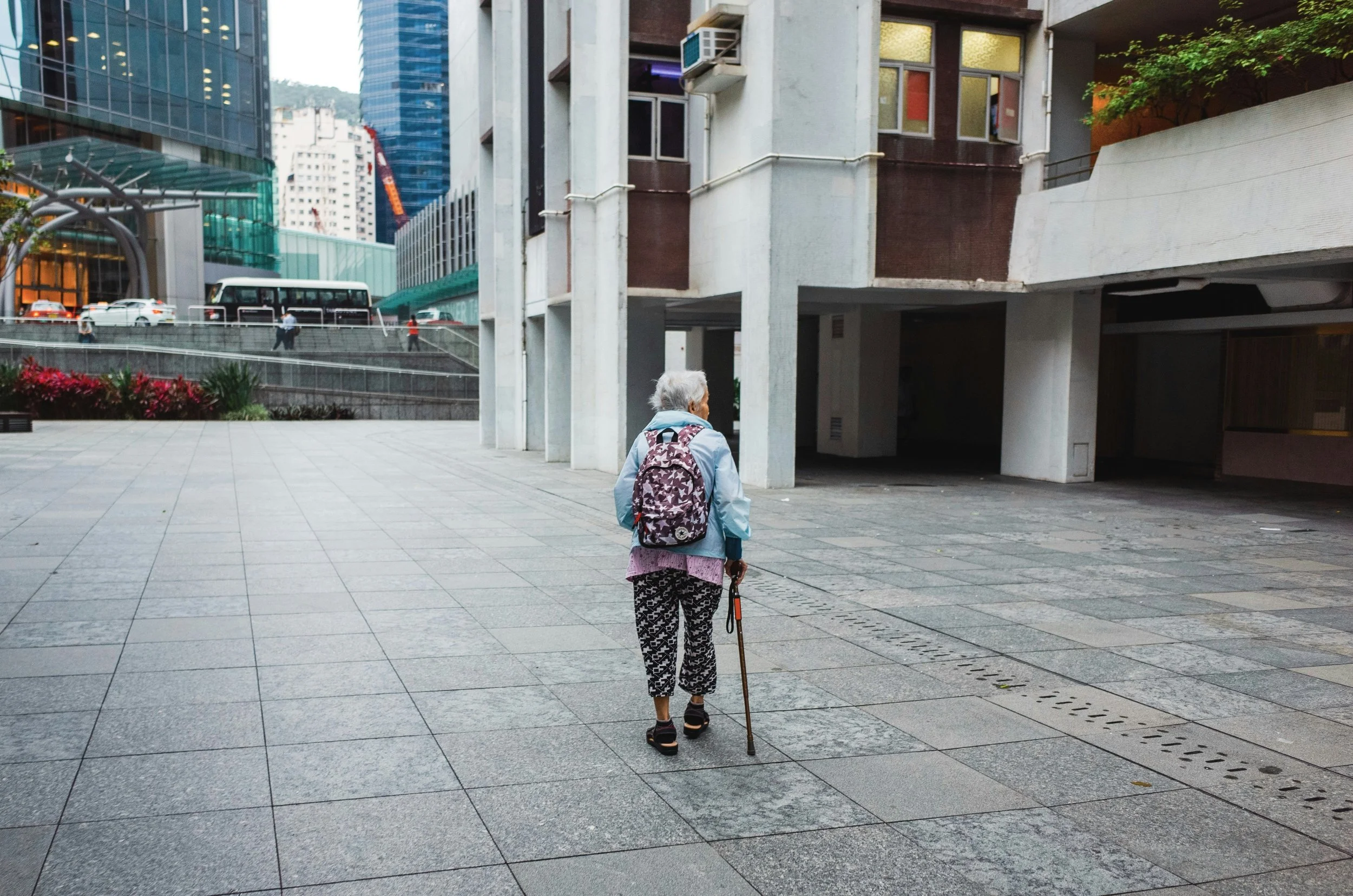
An elderly woman walking through Honk Kong pic: RICOH IMAGING COMPANY, LTD., GR
Hong Kong is globally renowned as a bustling international financial center, but it also holds a more personal distinction: it is home to one of the world's longest-living populations. However, this longevity brings significant demographic challenges. According to the Census and Statistics Department (CSD), it is projected that 34% of the population will be aged 65 or older within the next 15 years. Currently, the gender balance tilts significantly toward women, with only 756 males for every 1,000 females.
Hong Kong’s high life expectancy is rooted in several understated but vital factors: a robust public healthcare system, urban design, and dietary habits. Unlike car-dependent cities, Hong Kong’s "walkable" infrastructure typified by the ubiquitous network of footbridges and stairs encourages an active lifestyle. This daily physical activity provides exercise opportunities that are often missing in more sedentary cultures. Despite these healthy habits, the sheer volume of seniors is daunting. According to CSD projections, the elderly population will double to 2.44 million by 2066. At that point, the elderly dependency ratio will reach a critical level, with only 1.48 working-age people available to support every senior. Currently, Hong Kong’s advanced medical system remains a pillar of support. Low-cost medications and consultation fees (typically £15 for outpatient services and 50p per medicine) allow patients to access quality care without a heavy financial burden. However, Hong Kong’s rapidly aging population places increasing pressure on medical services (K. Wong & Young, 2019). To maintain operational efficiency and prevent skyrocketing wait times, the government must strategically overhaul the healthcare system to withstand this rising demand.
In Hong Kong, retirement typically occurs between ages 60 and 65. As many seniors remain healthy and capable, they often wish to continue contributing to society and sustaining their income. Unfortunately, a "skills gap" is emerging. Employers often hesitate to hire those over 60 due to safety concerns or perceived physical limitations. Meanwhile, the younger generation, often more highly educated who are less inclined to take on physically demanding labor. This is where the concept of "Active Aging" becomes essential. Active aging is not just about staying busy; it is a complex combination of physical, cognitive, psychological, and social factors, highlighting one’s enhancement or diminution of concrete powers of activity at old age (Marsillas et al., 2017; Steiner et al., 2011). Staying in the workforce provides seniors with mental stimulation and vital human interaction, reducing the boredom and cognitive decline often associated with living alone.
Retirement often brings a loss of steady income, making the Mandatory Provident Fund (MPF) a critical tool. It is a tool enacted in 1995 that helps Hong Kong’s workforce save up their monthly income for retirement. Both employers and employees are required to contribute 5% of their relevant income with a maximum of £3000 per month to the employee’s MPF scheme. While this compulsory 5% saving scheme encourages financial discipline, many wonder if it is sufficient. With some estimates suggesting a comfortable retirement requires at least HKD $5 million (roughly £500,000), the 5% contribution rate may need to be re-evaluated, perhaps with adjustments based on specific occupations and income levels. Furthermore, the "digital divide" remains a hurdle. As everyday tasks - from ordering food via QR codes to receiving instant news move online, many seniors feel left behind. An earlier study in Hong Kong found that older people mainly focus on the basic functions of the mobile phone (K. Chen et al., 2013). Initiatives like the Jockey Club SMART Family-Link Project are vital in bridging this gap, creating cutting-edge approach to delivering family services using technologies and data analysis (Hong Kong Jockey Club, 2011), especially as many younger residents migrate abroad.
Urban renewal in districts like Sham Shui Po where low-income seniors are concentrated in subdivided units often displaces the elderly. Many find themselves with few housing alternatives due to limited income or a lack of mortgage credit (Flowerdew, 1976; Turner & Donnelly, 1980). It is a heartbreaking reality that many who worked their entire lives do not have adequate shelter in their final years. Interestingly, this struggle isn't limited to low-income groups. Highly educated professionals also face ageism. In documentaries, PhD holders have shared stories of applying for simple clerical work just to stay engaged with society, only to be rejected because they are "overqualified" or seen as a "bad investment" due to their proximity to retirement. Social enterprises like Gingko House prove that senior employment works. By benefiting over 2,000 seniors through hiring in restaurants and shops, they provide a platform for social interaction and dignity. However, the government cannot rely on the private sector alone. Instead, it should create enrichment centers where highly educated seniors can pass their lifelong skills to the younger generation.
Active aging should never be just a slogan; it must be an action. We must cultivate a society that is patient, inclusive, and recognizes that everyone will grow old one day. Seniors should not be viewed as a burden to be managed, but as a treasure to be cherished.
References:
Census and Statistics Department (2023). Hong Kong Population Projections. [online] www.censtatd.gov.hk. Available at: https://www.censtatd.gov.hk/en/EIndexbySubject.html?scode=190&pcode=FA100061.
HONG KONG : THE FACTS Mandatory Provident Fund. (n.d.). Available at: https://www.gov.hk/en/about/abouthk/factsheets/docs/mpf.pdf.
Hui, E.C.M. and Yu, K.H. (2009). Residential mobility and aging population in Hong Kong. Habitat International, 33(1), pp.10–14. doi:https://doi.org/10.1016/j.habitatint.2008.02.001.
Lee, V., Cheng, D.Y.Y., Lit, K.K.D., Buaton, H. and Lam, E. (2025). Active ageing in the digital era: the role of new technologies in promoting the wellbeing of older people in Hong Kong. Asia Pacific Journal of Social Work and Development, pp.1–20. doi:https://doi.org/10.1080/29949769.2025.2457363.
Mpfa.org.hk. (2021). Available at: https://www.mpfa.org.hk/en/mpf-system/background/how-is-mpf-protected [Accessed 15 Feb. 2026].
