

The Gul Plaza Fire: Pakistan’s Pattern of Administrative Inefficiency
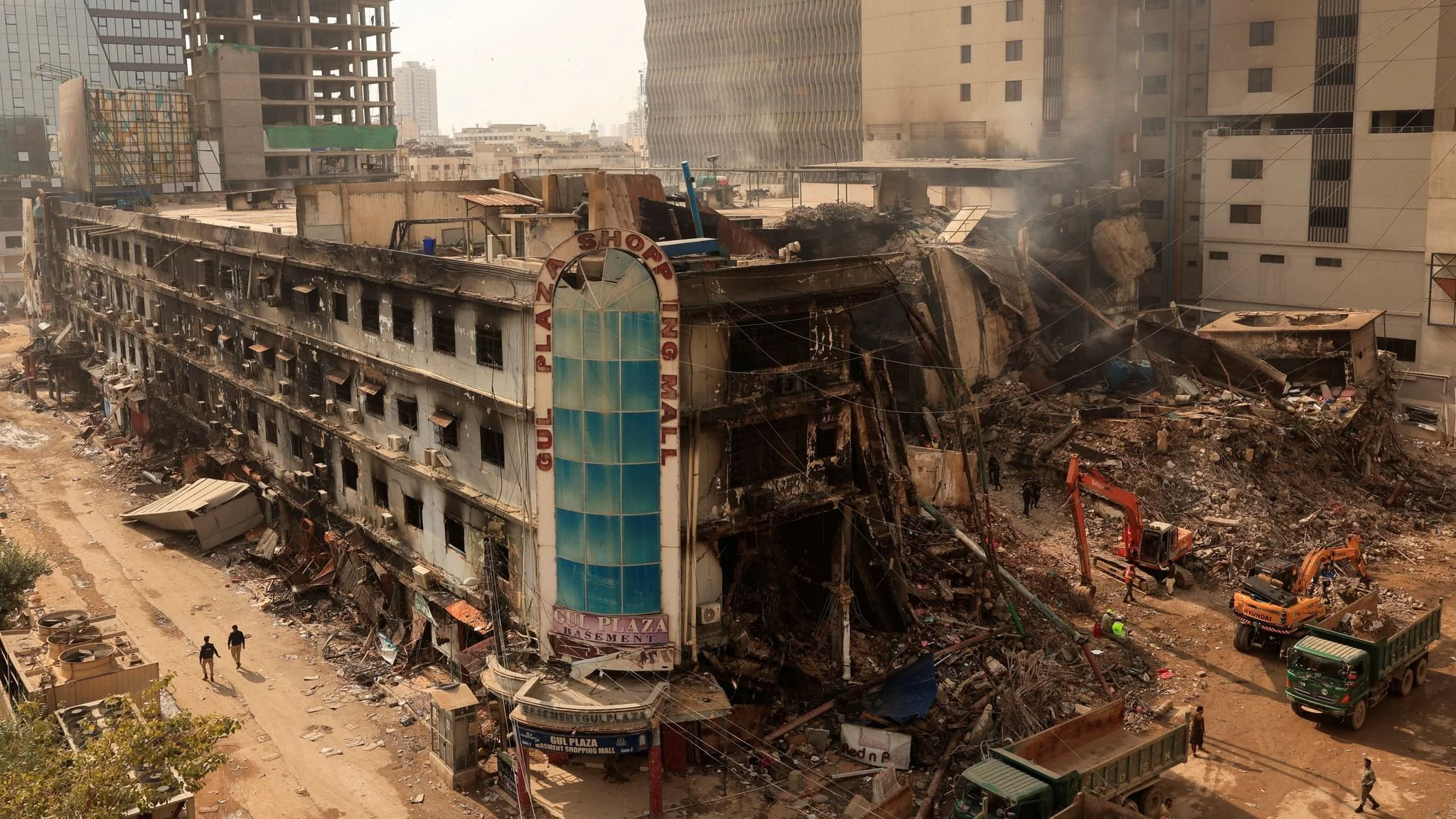
The remains of the Gul Plaza shopping centre. Pic: Reuters
Karachi is often described as ‘The City of Lights’, with its bustling roads, diverse communities, and teeming marketplaces. But on the night of January 17th 2026, the noise gave way to sirens and smoke as a massive fire tore through Gul Plaza, one of the city’s most familiar shopping landmarks. Up to 80 people have been confirmed dead, many others are still missing, and a structure that once housed 1,200 shops has been reduced to rubble (Latif, 2026). By first analysing the state of fire safety standards in Karachi, and then zooming out to examine the wider systematic inefficiencies of the bureaucracy, it becomes clear that Pakistan is suffering an administrative crisis.
The tragedy has once again forced Pakistan’s largest city to confront an uncomfortable truth. In Karachi, fire is not an accident. It is a pattern.
A City Built on Risk
Reports have illustrated consistent and clear incapacity to meet specific fire safety standards. This is to the extent where institutions that are specifically established to support fire safety are almost non-existent, due to the lack of government fundings amongst other things. A 2023 government fire safety audit in Sindh province, whose capital is Karachi, found that only 6% of buildings in the city’s three major commercial centers had proper fire safety mechanisms in place (Latif, 2026). Such a deficiency in effective safety measures is alarming.
In the wake of the disaster, a number of government officials have expressed condolences supplemented with lukewarm admissions of the lack of fire safety mechanisms. For instance, Karachi Commissioner Syed Hassan Naqvi, who is heading the inquiry committee formed by the Sindh government to investigate the Gul Plaza blaze, acknowledged that the building’s fire safety measures did not meet international standards. However, for many residents, that admission was less a revelation than a confirmation. Vague apologies do not seem to be able to neutralise the growing discontent and apathy Karachites are feeling towards their government.
Karachi has a long and tragic history of fires, the majority of which resulted in very little accountability and institutional improvements. For instance, in November 2023, a fire at a shopping center killed 10 people and injured 22. In 2012, a catastrophic fire at a garments factory claimed 260 lives. As the deadliest disaster to date, the Gul Plaza fire has renewed criticism and backlash against the administration and its consistently poor attempts to bolster safety measures.
Such a chain of repeated disasters illustrates the pattern of failure that mars the history of the Pakistani administration. Worst of all, this puts the lives of ordinary, tax-paying citizens at risk.
What Happened at Gul Plaza
Gul Plaza was one of a few iconic places for shopping, aside from the newer commercial malls, “where affordability, convenience and variety converged,” (Zaman, 2026). Built in the 1980s, the centre grew into a retail ecosystem of its own. In a city plagued by inequality, this mall stood the test of time as one of the places where middle-class families and working-class traders could interact (Zaman, 2026). Without painting too romantic of a portrait, one could easily argue that the Gul Plaza was firmly ingrained within Karachi shopping culture.
In the ongoing court case, witnesses have brought forth evidence suggesting that the fire started when minors allegedly ignited material inside a shop selling artificial flowers (Latif, 2026). Whilst this story and evidence may hold true, investigators admit, it is only part of the story. What turned a small fire into a catastrophe was the absence of working fire exits, the density of shoppers and stalls crammed into the building, as well as the lack of basic suppression systems.
The slowness of the response, wherein the firefighting was delayed and rescue workers spent at least 10 days combing through the remains of the 6,500-square-meter complex. The long search raised uncomfortable questions about urban governance, fire preparedness and rescue capacity. Why did it take so long? Why did so many people remain trapped? Why were emergency systems not in place in a building that had already experienced previous fires in 2008 and 2016?
The official inquiry, constituted on January 19th, submitted a 21-page report within nine days. It listed 17 findings and 5 recommendations, reviewing CCTV footage, recording witness statements, and documenting dispatch timings (Zaman, 2026). What it omitted was far more insightful. By offering no forensic determination of the fire’s cause, no technical analysis of building compliance, and no meaningful assessment of regulatory failures, it treated the disaster as an isolated tragedy rather than part of a recurring pattern. The inquiry seemed to narrate the disaster rather than interrogate it.
Governance by Abdication
Gul Plaza’s evolution mirrors Karachi’s broader urban planning tendencies. Originally approved for fewer floors, additional storeys were later legalized under successive political regimes, despite the absence of rigorous fire safety audits. No-objection certificates were issued despite the absence of rudimentary fire suppression systems.
This was not a bureaucratic oversight. It was “governance by abdication,” (Zaman, 2026).
Sindh’s provincial government has since formed a judicial commission to examine building approvals, evacuation routes, fire safety audits and possible negligence. Yet skepticism runs deep. Opposition parties, including the Pakistan Tehreek-e-Insaf (PTI) and the Muttahida Qaumi Movement, as well as some shopkeepers, have accused authorities of failing to launch a timely rescue operation that might have saved lives.
In the immediate aftermath, the municipal commissioner of the Karachi Metropolitan Corporation (KMC) was removed in a knee-jerk reaction. The DIG traffic Karachi was also transferred, though reportedly for unrelated reasons (Zaman, 2026). But these moves felt, to many, like reflexive gestures rather than systemic reform.
No serious reckoning followed.
The Firefighting Gap
Trained firefighters form the backbone of a fire safety system, and by international standards, Karachi falls severely short. Last year, approximately 1,700 fire incidents, mostly small-scale, were recorded across Karachi. The megacity currently has nearly 1,000 trained firefighters which is significantly less than the 15,000 and 20,000 International standards suggest (Latif, 2026)
Other measures of fire safety, such as the number of fire stations operated in relation to the population, and the water connectivity capabilities of fire stations, see Karachi fail to meet international standards also. For instance, the Karachi Metropolitan Corporation (KMC) operates just 30 stations, despite the fact that by global benchmarks, which recommend 1 fire station per 100,000 residents, the city would need around 200 stations. Moreover, around 17 out of 28 stations reportedly lack water connections for storage (Latif, 2026) . As a city extremely vulnerable to industrial and electrical fires, these statistics paint a dismal portrait of the fire safety system and the dangers it places on residents.
Analysing disaster response generally in Karachi allows us to see how fragmented the bureaucratic system is. There is no unified incident command structure with the legal authority to override bureaucratic silos, mobilise civil agencies and requisition paramilitary support when necessary. Emergencies are often managed by committees and parallel press briefings. Consequently, crucial time is lost and time, in a fire, can save the lives of so many.
Urban planner Arif Hasan in an interview with Anadolu news agency has long warned that a lack of planning, maintenance and monitoring, alongside the non-implementation of fire regulations, has been the driving force behind such disasters (Latif, 2026). A holistic approach, he argues, involving regular inspections, enforcement of standards and modern firefighting systems, could significantly mitigate risks. Many agree but argue a stronger focus on accountability measures is needed to enforce current safety laws.
Similarly, planning expert Amber Alibhai in an interview with Anadolu points to the relentless demand for housing and commercial space, combined with lax enforcement of building laws, as creating fertile ground for illegal constructions where fire safety is not a priority (Latifo, 2026). Later, these buildings are often regularised. She calls for transparency in construction approvals and an absolute halt to the approval of illegal structures.
A System That Forgets
One of the most troubling aspects of the Gul Plaza inquiry is its silence on the past. By failing to acknowledge that Gul Plaza had suffered multiple previous fires, the inquiry effectively erased institutional memory. And without memory, there is no accountability.
Unfortunately, enforcement remains lax, audits sporadic and political will inconsistent.
The ruling Pakistan Peoples Party (PPP), which has governed Sindh since 2008, now finds itself under renewed scrutiny. But this is not a crisis that belongs to one party or administration. It is structural as it is embedded in the way responsibilities are diffused. Most critically, the system lacks decisive executive leadership during emergencies, requiring someone with both the authority and responsibility to coordinate a unified response.
The Wider Pakistani Context
The events surrounding the fire at Gul Plaza point to wider administrative problems that go beyond Karachi. Pakistan’s system of governance is structured across local, provincial and federal levels, but coordination between these layers is often weak. Duties such as urban planning, safety inspections and emergency response are spread across multiple departments, with no clear chain of command during crises. When something goes wrong, responsibility becomes blurred, making it difficult to hold any single authority accountable.
Moreover, successive governments have relied heavily on post-crisis responses instead of preventive planning. Public inquiries and official statements create the appearance of action, but rarely lead to structural reform or sustained oversight. Administrative reshuffles substitute for accountability, while systemic issues, such as weak monitoring mechanisms and limited consequences for negligence, remain untouched.
Karachi’s residents deserve more than condolences and committees. They deserve buildings with functioning fire exits, ventilation systems and alarms. They deserve fire stations with water. They deserve a system that enforces its own rules before tragedy strikes rather than after.
The only way to move forwards is for people to recognise that Gul Plaza was not an anomaly. It was a warning.
Reference list
Jazeera, A. (2026). Death toll in Pakistan shopping centre fire rises to at least 67: Officials. [online] Al Jazeera. Available at: https://www.aljazeera.com/news/2026/1/22/death-toll-in-pakistan-shopping-centre-fire-rises-to-at-least-60 [Accessed 16 Feb. 2026].
Latif, A. (2026). City at risk: Karachi mall fire exposes dangers of unchecked urban growth. [online] Anadolu Agency. Available at: https://www.aa.com.tr/en/asia-pacific/city-at-risk-karachi-mall-fire-exposes-dangers-of-unchecked-urban-growth/3820006 [Accessed 16 Feb. 2026].
Zaman, F. (2026). COMMENT: Anatomy of a foreseeable disaster. [online] Dawn. Available at: https://www.dawn.com/news/1972582 [Accessed 16 Feb. 2026].
