

When Democracy Fought Back: Martial Law, Mass Resistance, and What the World Can Learn from South Korea
(Photo by Presidential Office of South Korea)
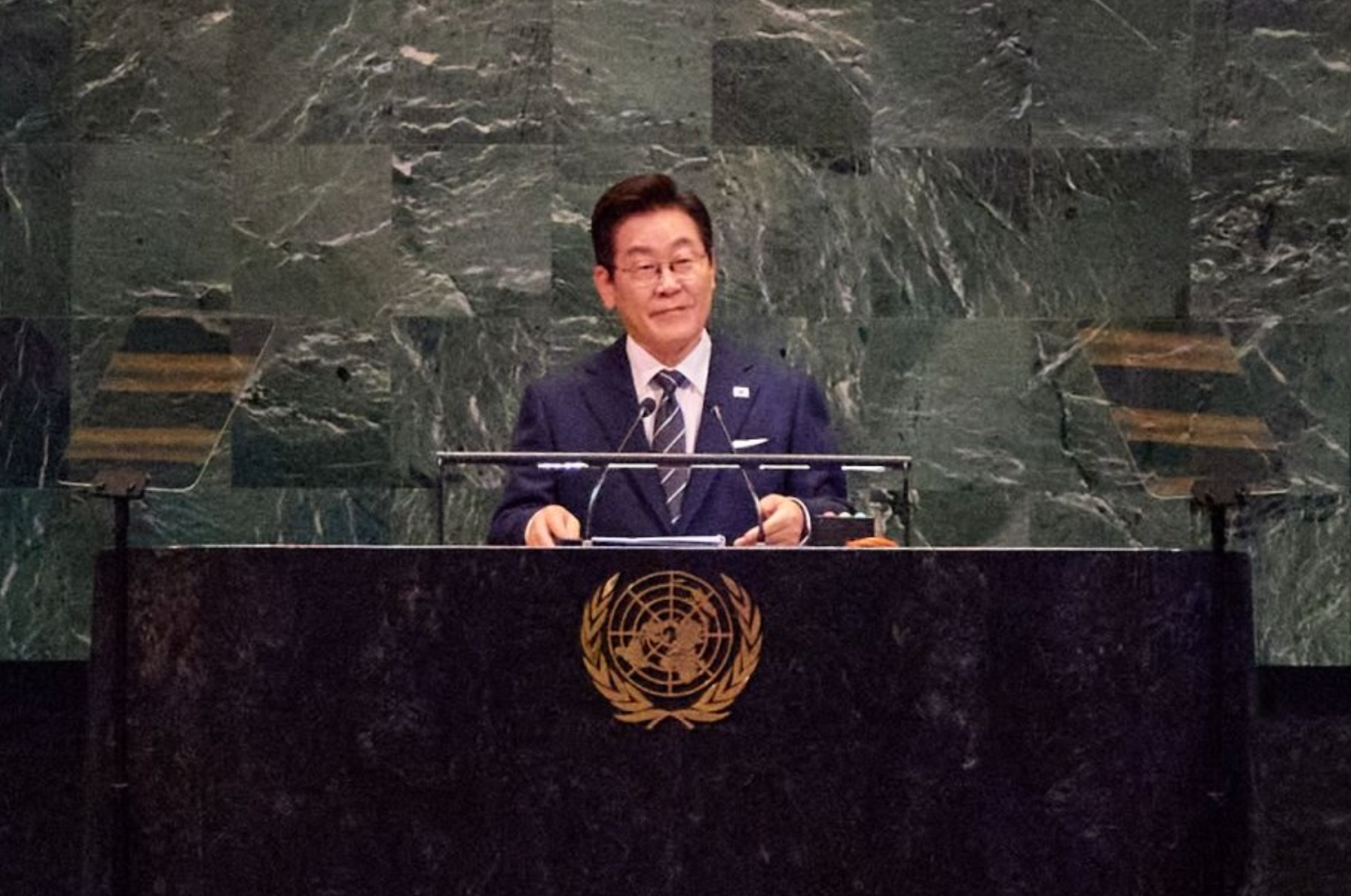
Last September, before the assembled dignitaries of the United Nations General Assembly in New York, South Korea’s newly elected President Lee Jae-Myung declared in his speech that this "small nation in the Far East" now stands as “a guiding light for all those, around the world, who are willing to follow the path of democracy.”
But what led President Lee to make such a bold claim?
Martial Law
On December 3, 2024, South Korea faced its most serious attack on democracy in decades. Former President Yoon Seok-Yeol, in an extraordinary late-night address to the nation, declared Martial Law, as the "majority opposition party in Parliament has been paralysing the state” and that there was a “need to exterminate anti-state subversives from within”.
However, Yoon’s claim that the opposition was ‘paralyzing the state’ inverted reality. His approval ratings had plummeted to the low 20s amid mounting scandals: his wife Kim Keon-hee faced allegations of stock manipulation and accepting luxury goods, while Yoon himself stood accused of abuse of power. When the opposition-controlled Parliament launched corruption investigations and attempted to appoint an independent counsel, Yoon vetoed the measures repeatedly. The ‘paralysis’ Yoon decried was largely of his own making — a president who refused to govern democratically when democracy didn’t bend to his will.
But the legitimacy of his grievances mattered little in the moment. Yoon had seized immense authoritarian power. And use this power he did.
Proclamation No. 1 of Martial Law was to ban all political activity for members of Parliament. Proclamation No. 4 banned any activity that "may cause social unrest", effectively banning all forms of dissent. Those who disobeyed could now be arrested, detained, and executed without warrant, under Proclamations No. 9 and 14. The military were to be given live ammunition to enforce these draconian measures. Most frightening of all, there were no conditions under which these proclamations would expire; these anti-democratic “laws” were here to stay.
Yet the people, in face of state-sponsored violence of the highest level, remained unfazed. Few were convinced that the solution to partisan politics was to get rid of the opposition — South Koreans are by and large proud of their democracy, while seeing their authoritarian, one-party rule neighbours in North Korea falter under poverty and corruption. Many soon realised this was in fact a self-coup, a ploy played by Yoon to make himself dictator through brute force.
One Man Jumps, A Nation Follows
Only minutes after the proclamation, Lee Jae-myung, then leader of opposition in Parliament, was already on-route to Yeoido, a district in Seoul that hosts the Parliament Building. As Lee recalls in his most recent book, It’s the People Who Make It Happen, his wife raced along the streets of the nation's capital, while Lee started live-streaming his now "illegal" actions from the passenger seat. He asked fellow MPs and citizens to gather in Yeoido and at Parliament, as he predicted the military would soon be present. The plan was simple — as the South Korean Constitution has a safeguard mechanism to prevent abuse of this kind, namely a simple majority vote in Parliament to annul Martial Law, this was to be done in utmost haste. Ironically, the military now had the power to block, arrest, and if need be, shoot MPs from doing so. Hence, the call for ordinary citizens to gather on Parliament grounds — surely not, the soldiers wouldn't dare shoot their fellow countrymen, vulnerable and unarmed.
Lee proceeded to film himself jump over a yet unguarded part of the fence that surrounds Parliament. More than half of his colleagues soon followed, and as soldiers refused to use violence against citizens who had risen to Lee’s call to assemble, 190 MPs unanimously voted to annul Martial Law. It took them 2 hours and 32 minutes, from the second Yoon had made his declaration.
The following week, on an extraordinary Saturday session of Parliament, a supermajority of MP's voted to impeach Yoon, suspending his powers until a final verdict could be made by the Constitutional Court. In January, the South Korean Police Force arrested and detained Yoon, a first for an incumbent South Korean President. By April, judges of the Constitutional Court of South Korea, the highest court in the land, had ruled unanimously to uphold Yoon's impeachment, paving the way for a snap-election in June. The citizens of South Korea were now free to democratically elect a new leader of their choice. Power, which had briefly been wielded in the hands of a violent, would-be dictator, was handed back to the people.
Working Within the Existing Legal Framework
Although Yoon’s actions were irrational and anti-democratic by definition, he did abide by the law — the President holds the legal right to declare martial law in an emergency and proclaim extra-judicial measures deemed fit. Despite Yoon’s dubious interpretation of the law, the opposition nevertheless responded with patience and restraint, staying within the bounds of South Korea’s legal system. Arguably, this allowed a swift and successful suspension of Yoon's power, and finally his deposition, which prevented what could have been a dramatic backsliding of democracy for South Korea.
Larry Diamond, a scholar in the field of democracy studies, states in his work on the topic of Democratic Recession, that “every established democracy is equipped with institutional mechanisms of self-correction [...] that are designed to prevent the concentration of power and the erosion of democratic norms.” Democratic backsliding, then, is rarely a failure of institutional design, but rather a failure of will — a choice not to activate the safeguards that already exist. The South Korean Constitution of 1987 is far from perfect — partisan gridlock has prevented a single amendment in nearly four decades. Yet it still fulfilled the task of repelling authoritarianism. Fulfil it did, but only because politicians and judges had the will and courage to uphold it.
Furthermore, as Yoon and his ministers were successively impeached or resigned for their actions, continuity of government was ensured under the constitutional line of succession. By May, the Minister of Education held the top job as acting President, Prime Minister, and Minister of Finance. This left little room for social unrest. Even as political chaos on an unprecedented scale unfolded in the months following December 3rd, the South Korean people were able to carry on with minimal disruption to their daily lives.
Ultimately, South Korea’s experience demonstrates that the surest way to defend democracy is not to abandon its laws in moments of crisis, but to wield them with conviction against those who would subvert them.
In Great Numbers: Peaceful and Pluralistic Resistance
Arguably, the actions of lawmakers, policemen and the Constitutional Court judges were only made possible by loud outcry from civil society that demanded action. As Parliament convened for its extraordinary session shortly after Yoon's Martial Law fiasco, a protest gathered in Yeoido demanding Yoon’s impeachment. Connie Lee, a housewife who lives in the suburbs of Seoul, set out with her family on that Saturday to make their voice heard to lawmakers. However, they were stopped far from the Parliament Building. "There were a sea of people, so many we could only make it to the side streets of Yeoido. The (Parliament) Building was nowhere to be seen" she recalls. "Apparently we had gathered in such great numbers that the cell networks went down. I only knew he (Yoon) was impeached when we heard a roar of joy cascading down from the crowd". Approximately 2 million had gathered in the small island district of Yeoido that day, in one of South Korea’s largest political protests in history.
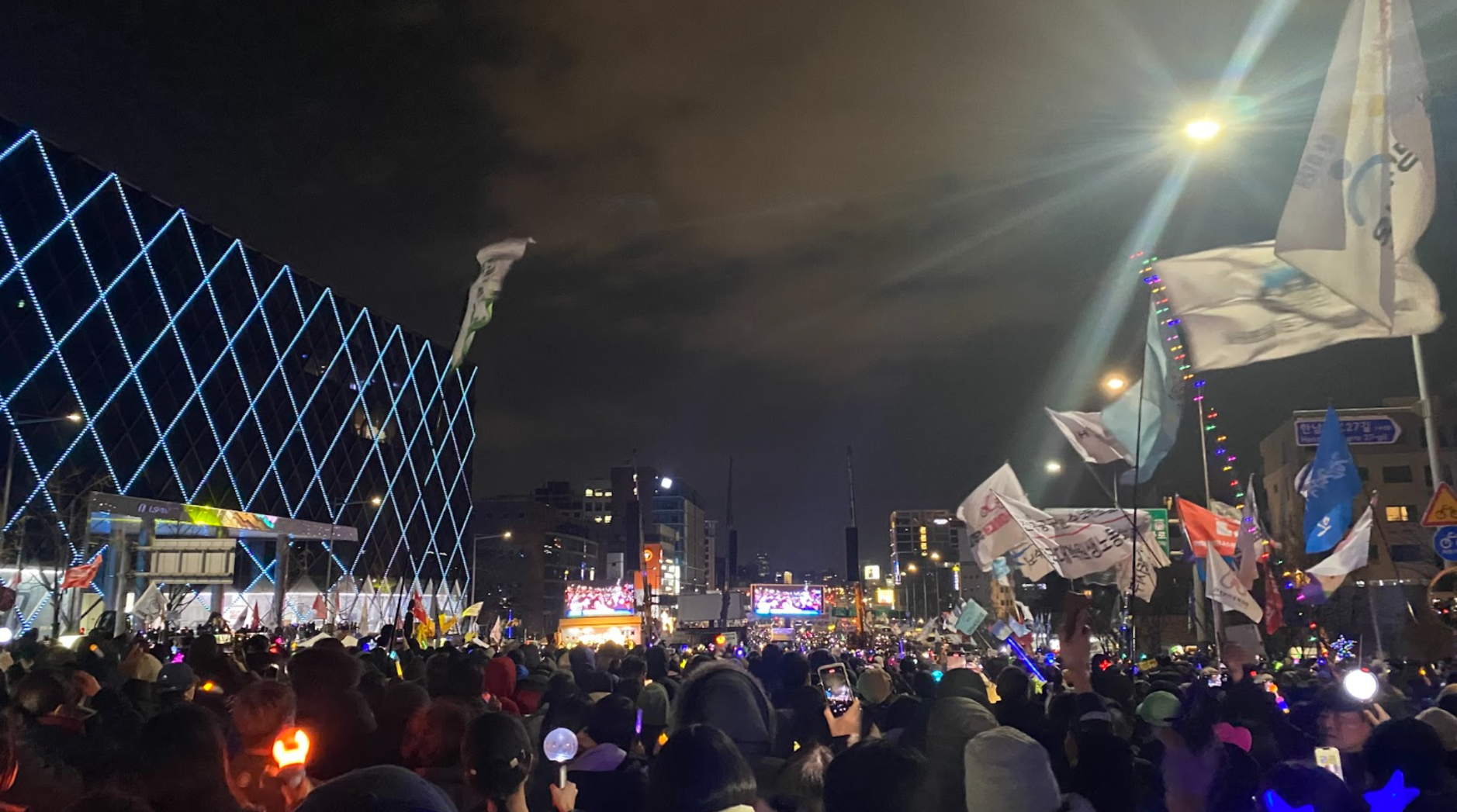
I had the pleasure of attending a protest myself on the evening of January 4th, during a visit to see family members in Seoul. Held on the streets outside Yoon's residence, the occasion called for Yoon's arrest, and for South Korea to keep faithful to its constitution. What struck me first was how peaceful and orderly the protesters conducted themselves, despite the sheer number of people present; I was unable to see the end of the crowd in any direction. The blaring music of upbeat K-pop helped give the protest a festive atmosphere — a creative way to channel the crowd's anger in a peaceful way, and to keep warm as temperatures reached well below -10 that evening.
(Photo by Writer)
The bitter cold didn't seem to faze the crowd at all, of which I had begun to notice came from all walks of life. Jay Kim, a Seoulite accountant in his 50s who enjoys his free-time enjoying motorsport, decided on this occasion to protest instead. "I don't usually follow politics, but this is a matter beyond that. It's about whether we, as a people, are able to resolve our differences peacefully and in a democratic manner" said Mr Kim. This pluralistic sentiment seemed not to be a unique view, as I noticed flags being waved, from what seemed to represent every political, social, and economic sector of South Korean society. Pride flags flew next to flags from the socially conservative Democratic Party, an elderly rights group flew their flag next to a group of young climate activists. Regional representatives from the South-West and South-East stood side by side. A priest and a monk shook hands.
To say I was surprised would be an understatement. This is the very country that suffers from decades of sectarian division along political, generational and regional lines. A country with one of the poorest records on LGBTQ+ and women’s rights in the developed world. Despite South Korea’s profound social fractures and decades of antagonism between these very groups, they seemed not to raise their own doctrines, but rather band together to fight for a society that respects democracy and the constitution first and foremost. In a world where dogma so easily divides, South Korea’s streets offered a reminder that democracy’s true strength lies not in unanimity, but in the collective refusal to silence difference.
Remembrance of the Human Cost of Democracy
One of the protest chants I heard that day was “can the dead save the living?” — in reference to South Korean novelist Han Kang’s line from her widely acclaimed work, Human Acts. The novel centres around remembrance of the Gwangju Uprising in 1980, when citizens of Gwangju, a provincial city in the South-West, refused to adhere to military general Chun Do-Hwan’s declaration of Martial Law on May 17th that year, a coup that ended hopes of transition to democracy. While the rest of the country stood down in fear, protests in Gwangju continued despite ever increasing military violence. The final straw came on May 21st, when the army gunned down a sea of protesters in central Gwangju. The following day, the people rose up in such numbers that Chun’s forces were forced to retreat - a spontaneously formed “citizen’s army” took control of the city. For five extraordinary days, power lay with the people of Gwangju. This was met with a full-scale invasion by Chun’s forces; by May 27th, he had recaptured the city and continued to rule South Korea under brutal dictatorship for another 7 years.
Countless lives were lost in Gwangju, but not without vain - their heroic resistance against unjust power cemented itself in history, for its sacrifice not in the name of ideology, religion or dogma, but for the people to have the right to decide this amongst themselves through democratic process. This faith in pluralistic self-determination inspired the June Revolution of 1987, when the military junta ran out of tear gas to disperse protests across the entire nation. Chun was promptly forced to step down, and South Korea's current democratic constitution was written — South Korea could now dare call itself a democracy. However, the trauma of events stayed in collective memory, which was rudely awakened by Yoon's declaration of Martial Law. Desperation never to relive this trauma again led protesters last winter to pose the question "can the dead save the living?" The answer was an overwhelming yes. Remembering well the horror of military rule, the people of present defended democracy with all their might, fuelled by courage inspired by those in Gwangju in the Spring of 1980. Hence, South Korea taught us that democracy endures through remembrance and the moral refusal to forget the price once paid for democracy.
"A Guiding Light for Democracy"
South Korea’s most recent defence of democracy was more than a domestic political victory — it set a global precedent for democratic resilience. Quickly recognising the threat of authoritarianism, South Korean citizens, lawmakers, and judges chose not the path of vengeance against its perpetrators, but of vigilance. To have the moral humility to act as a collective, mindful of the sanctity of democracy. They acted within the law, not above it, proving that democracy is measured by how steadfastly it abides to its laws and principles when tested.
As President Lee declared South Korea a guiding light for democracy at the United Nations, he cited Han Kang’s words in her novel, Human Acts, to lead “toward the light, where flowers are blooming”. This was not a mere display of national literary pride. It was an assertion of faith and hope: that this young democracy, once scarred by dictatorship, can illuminate the path for others. In an age when democracies across the world face their own crisis of legitimacy, South Korea’s story stands out in exception.
Not bad for a “small nation in the Far East”.
