

The Influence of Pre-Modern Asian Visions of World Order: The Indian Mandala and the Chinese Tianxia How ancient models of power continue to resonate in contemporary geopolitics
In the autumn of 1414, the courtiers of the Ming dynasty gathered in the capital, Nanjing, with great interest to greet a strange oddity that had never stepped foot on Chinese shores before, one that was gifted by the King of Bengal, Saif al-din, as tribute to the Yongle Emperor. It was not native to the Indian subcontinent; it had most likely travelled from the African coastal kingdom of Malindi, in present-day Kenya, before making its way to China. The tall and gentle animal was nonetheless presented to the imperial court as a qilin—a two-horned, vaguely chimeric creature with a dragon’s head, a deer’s body and ox’s tail, one of the Four Auspicious Beasts listed in the 禮記 (The Book of Rites), along with the dragon, the phoenix and the tortoise.
Today, we know that this extraordinary and fantastical creature was, in fact, a giraffe.
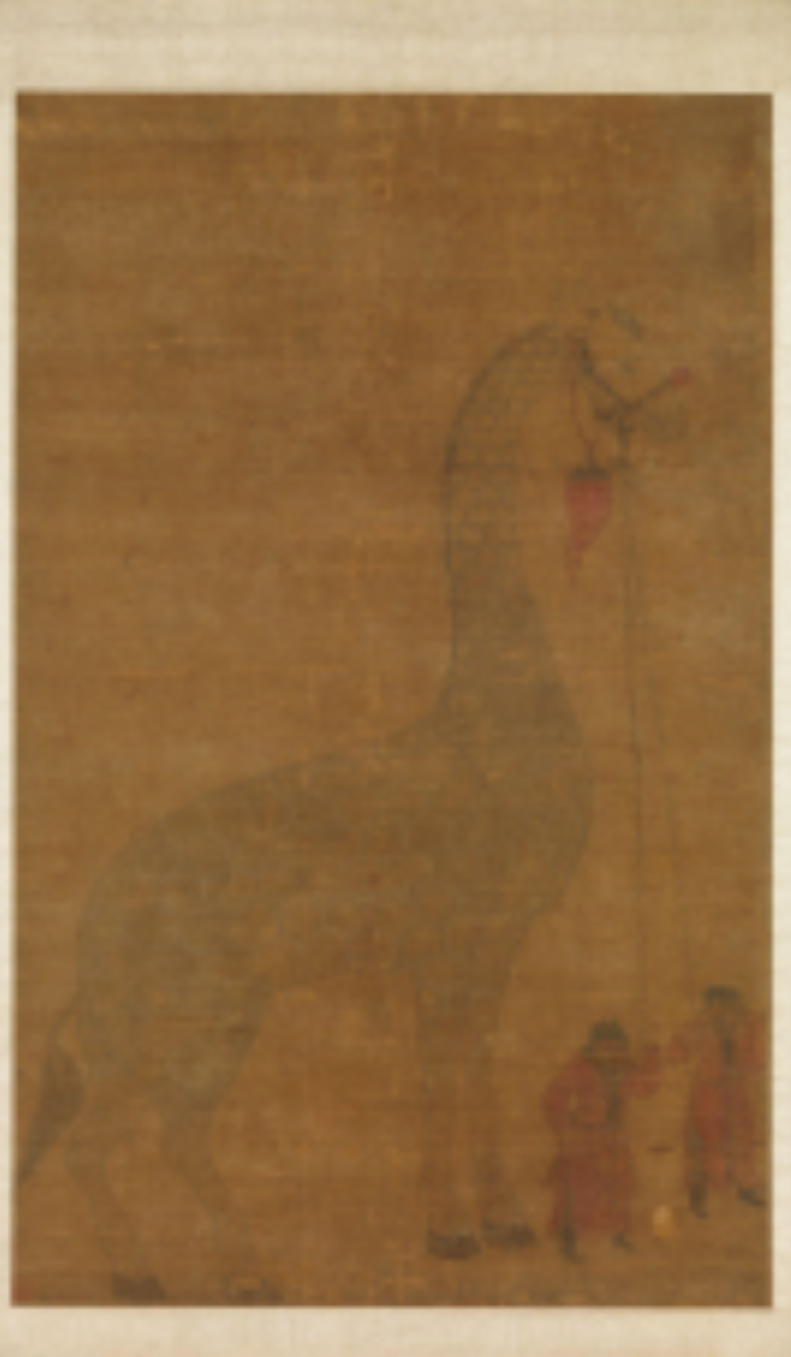
Giraffe with Two Keepers, Unidentified artist, Qing dynasty (1644–1911). The Metropolitan Museum of Art, Open Access.
However, it is indeed of peculiar interest, the choice to identify the nature of the giraffe as mythic rather than mundane, for while it held much novelty in its unfamiliar form, it was not particularly remarkable in any other way, and was not described as such before reaching the court. For instance, the soldier Fei Xin, one of many who served on Admiral Zheng He’s famed treasure fleets, merely referred to it in his accounts as the zu-la-fa, a direct transliteration of the Arabic word for the giraffe, zurafa. Certainly not as a qilin.
It then begs the question: why did the Ming court choose to see in its ‘exotic’ bearing a creature of legend rather than a curiosity of nature? Perhaps the answer lies less in the so-called qilin itself than in what it represented. In the classical imagination, the qilin was the symbol of benevolence and prosperity, emblematic of good governance and just leadership, a gentle giant appearing only during a golden age. A footnote from James Legge’s translation of the 詩經 (The Book of Poetry) describes it as unwilling to tread on any living thing, extending that compassion even to humble grass, and importantly, as capable of war, but willing to have peace, as embodied in its horns covered with flesh, a sort of strength voluntarily tempered by mercy. To see the giraffe as a qilin was a gesture of self-definition, an act of identifying righteous might.
The decision was then, as noted by Sally K. Church, likely—at least in part—political in nature. It could have helped affirm the legitimacy of the Yongle Emperor, a fourth son of the previous ruler, who had seized the throne after a bitter civil war and the overthrow of his own nephew. However emperor Zhu Di himself was not described as particularly superstitious about the supernatural significance of the qilin, albeit evidently being interested enough to commission a painting on it and sending several gifts back to Saif al-din, including swathes of velvet, brocade and silk. His officials saw it as a reaffirmation of the Mandate of Heaven after a precarious time, and Zhu Di, for all his scepticism and his refusal to receive any congratulatory memorials, made no attempt to stamp out the rumour, probably recognising that it ultimately worked in his favour and served to only burnish his image.
Even the furthest shores, it seemed, had felt the empire’s ‘virtue’ and responded in kind by sending a celestial omen to the heart of the Middle Kingdom. The outer world turned instinctively toward the moral light at its centre, the axis of civilisation ran through the throne of the son of Heaven still, and so forth.
This idea was an archaic version of tianxia, or as it is popularly translated to English, ‘all under heaven’—a phrase that sounds at once poetic and absolute. Yet the phrase invites a question of its own: what, in truth, does ‘all under heaven’ actually mean?
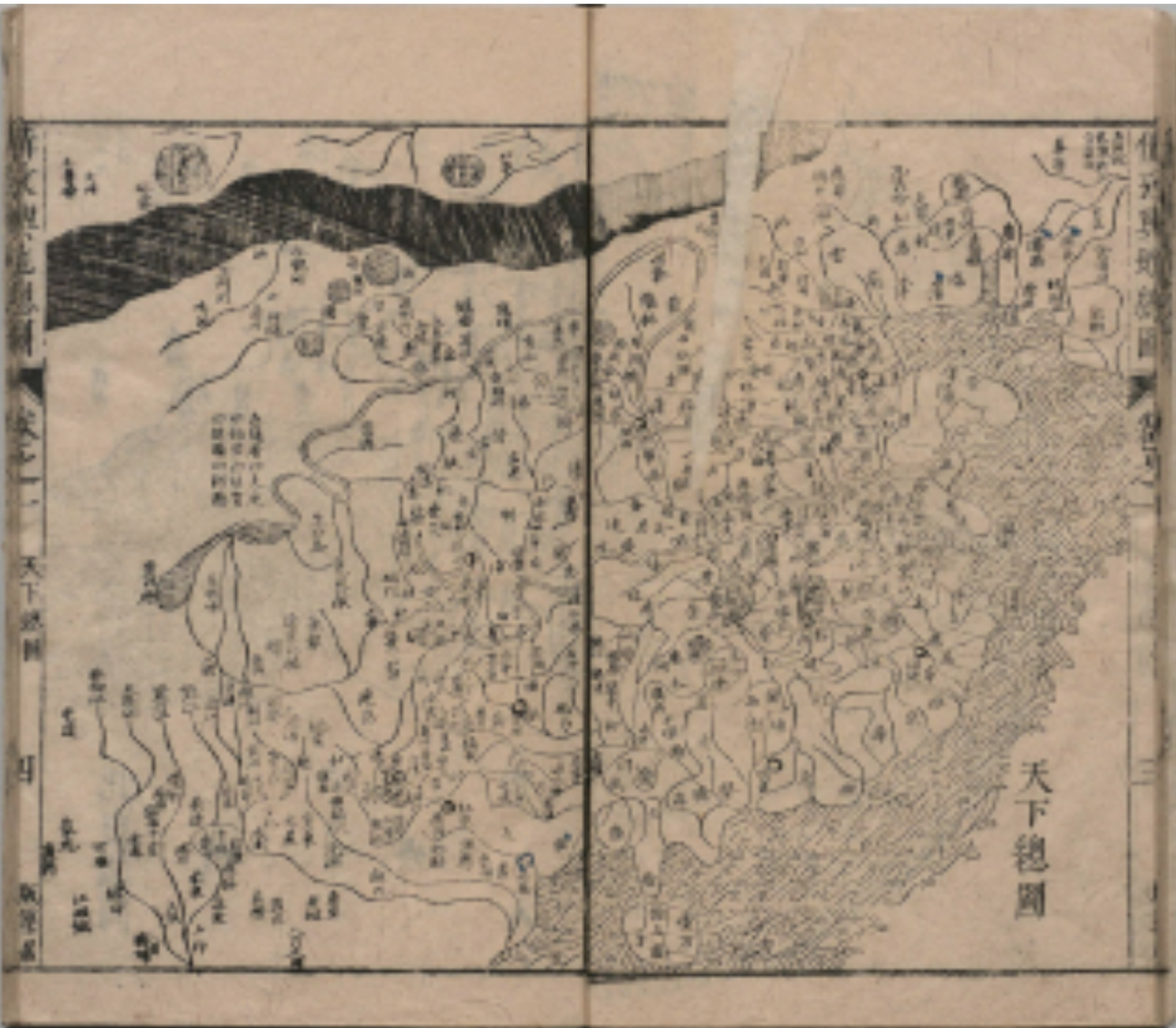
[ ‘Tianxia zongtu’ (Map of All Under Heaven) from Huiji yutu peikao quanshu (1633), via the National Archives of Japan, public domain. ]
It can be said that the kings of the far older Zhou dynasty were the first to formally practice this idea in their statecraft, and the idea has endured into the present after metamorphosing into various forms throughout the centuries as each dynasty reinterpreted it in line with the institutional and ideological conditions of its reign. The Zhou conception of the world rested on a “five-zone” system, a cosmography that was at once outward-spreading and inward-pulling, centrifugal and centripetal. According to legend, the model first appeared in The Tributaries of Yu the Great. It outlined five concentric rings through which the Zhou mapped their universe.
At the very centre lay the imperial capital, the dianfu, surrounded by the princely domain, the houfu. Beyond these stretched the binfu, or “zone of pacification,” charged with maintaining stability at the empire’s edges. Still further were the yaofu, the lands of semi-cultured peoples such as the Yi and the Man, and finally the huangfu, the desolate frontier inhabited by the ‘barbaric’ Rong and the Di. Though ostensibly geographic, this was also a moral map, a system of relationships and a catalogue of peoples arranged by proximity to civilisation. Each ring marked a degree of refinement radiating outward from the centre, and thus a supposed measure of distance from Heaven’s grace. For the Zhou rulers, this hierarchy defined how the “world beneath Heaven” was to be known, described, and governed. An atlas of hierarchy for a kingdom of kingdoms, so to say.
Nevertheless, by the time the Ming dynasty rolled around one thousand six hundred years later, the version of tianxia they practised was decidedly different from the Zhou, more emphasising its dominance and self-perception as a superior civilisation. As Junping Liu notes, the Ming understanding of Tianxia emphasised the cultivation of harmony and virtue within China, while extending these norms outward through diplomacy and the tributary system; seeking to define a social and ethical order radiating from the imperial centre.
Modern versions of this ancient concept have matured in ways that speak to a broader “world-scape.” The Chinese philosopher Zhao Tingyang argues that to “rule the world” is not necessarily to possess it. Dominion over land, armies, or borders does not amount to having hold of the world in a moral sense. Indeed, even the tianxia of the Zhou rulers appear to have reflected this distinction to some extent, for their conception of the world extended far beyond the territories they actually governed. In Zhao’s words, a ruler may seize territory, but never the hearts of all peoples; the world becomes real only when it is collectively willed into being, an idea that the 17th century thinker Huang Zongxi maintained before him—that the true measure of tianxia’s rise and decline lay not in the fortunes of dynasties, but in the joys and sorrows of those who lived within it.
Thus in this sense, tianxia can represent a ‘supranational’ imagination of universal cooperation depending on the capacity to align the interests of 'all under Heaven’, a sharp contrast with the Westphalian paradigm, where the world is divided into autonomous and competitive nation states. Contemporary politics, Zhao states, remains trapped between two inadequate ideologies: the universalism of powerful states, which often disguises imperial ambition, and the pluralism of weaker ones, which retreats into self-preservation. Both reflect philosophies of the world, framed by national interest, rather than philosophies for the world, which focus on universal wellbeing.
The failure of humanity, according to him, lies in our inability to think from the standpoint of the world as a whole—mundus qua mundus.

[ The founder of the Kuomintang Dr. Sun Yat-sen’s handwritten inscription “Tian Xia Wei Gong” (天下為公) — “What is under heaven is for all,” 1924. Image via Wikimedia Commons, public domain. ]
Whether China practically aspires to follow this particular version of tianxia in their approach to international relations today has been hotly contested by both Eastern and Western scholars. William A. Callahan argues that China possesses an enduring ambition to confront global challenges in a characteristically Chinese manner, reflecting a nationalist impulse to universalise its own problem-solving ethos, hence the West’s continuing mistrust and suspicion of China’s aspirations. Additionally, Mehmet Şahin points out that Zhao Tingyang’s formulation of tianxia contains an epistemological gap when measured against Western political theory. Whereas Western international-relations frameworks focus on explaining state behaviour as it exists, tianxia is more prescriptive in nature, an ethical vision of how the world ought to be. Zhao, Şahin notes, sets a Chinese utopia of “the world-as-one-family” against the empirical realities of the Westphalian system. He further argues that Zhao’s critique of Western politics leans heavily on practice, such as alliances, unions of states, and the shortcomings of the United Nations, while overlooking comparable episodes in China’s own modern history and neglecting Western normative projects such as Kant’s Perpetual Peace or Wilsonian internationalism.
Building on this critique, Şahin raises what he calls the authority problem within tianxia: if “all under Heaven” is to be unified, who then defines the moral principles of this unity? Although Zhao presents tianxia as an antidote to Western hegemony, Şahin argues, like Callahan, that its structure risks hypocritically reproducing a hierarchy of its own, with Chinese values positioned as the universal standard. He notes that the framework rests on three principles: advancing a conception of world order grounded in moral purpose, serving the great by the small in exchange for protection, and emulating Chinese standards of propriety in conduct and governance. Such a system, Şahin suggests, envisions China as the “harmoniser” of the world, claiming moral leadership while offering self-determination to others only under its guiding virtue.
Yet, other scholars have sought to defend tianxia against such critiques by returning to its classical roots. For example, Li Lin argues that such critiques overlook tianxia’s original ethical foundation, which lies in its resistance to true private or imperial possession. Drawing on the writings of Mencius, he states that tianxia belongs not to any single ruler, but to Heaven — and Heaven, metaphorically, represents both divine will and the collective will of the people. From this perspective, tianxia should not be considered an ideology of domination but moreso a framework for morality. Any attempt to codify or impose it forcefully through formal rules, Li Lin suggests, would undermine its essence. Instead, its vitality depends on the
principle of “nurturing people with benevolence,” which aims to unite internal and external policy under a shared sense of responsibility.
Li notes that modern tianxia manifests as a vision of the common good, better understood as a political ideal aimed at harmonising nations through mutual benefit and reciprocity. China’s foreign and economic initiatives, such as the Belt and Road Initiative, are often framed by the government within this vocabulary of good-natured and munificent stewardship, presenting cooperation as participation in a shared moral order. Whether this represents continuity with older ideas of Tianxia or a strategic rearticulation of it remains open to debate, but the enduring appeal of the concept lies in its promise of unity without subjugation.
[ 18th century Map of the Indian Ocean by French geographer Jacques Nicolas-Bellin. Image via Wikimedia Commons, public domain. ]
China is not the only country in Asia to look back to its civilisational past in search of intellectual foundations for its foreign policy. Its neighbour to the southwest, India, likewise possesses a long and rich history of distinctive political thought. Among its earliest articulations of world order was the concept of the mandala. A system not entirely unlike the Zhou vision of tianxia, in that both may be understood, in a loose sense, as forms of ‘galactic polities’.
Three centuries before the birth of Christ, a scholar stood humiliated in the court of the king of Magadha, Dhanananda, in what is now the Indian state of Bihar. His birth name was Vishnugupta, but history would later famously remember him as Chanakya. According to historical and artistic accounts such as the Mudrarakshasa and the Mahavamsa, he was insulted and cast out by the prideful king. Enraged, he was said to have loosened his sacred topknot in vengeance and swore to not tie it again until the dynasty that had mocked him was overthrown. Amid the upheaval left by Alexander the Great’s brief but seismic invasion of India’s northwest, he wandered through the fractured kingdoms of the Gangetic plains plotting
his revenge. It was then that he found an odd if promising ally in a young boy of obscure birth, in whom he recognised and stoked a fierce ambition to rule.
Whether the tale of his humiliation is literal or embellished, the historical record confirms what the story suggests: the hubris of the Nanda king proved his undoing, for the boy under Chanakya’s wing would grow up to become the Emperor Chandragupta Maurya. And indeed, Chanakya ended up playing a decisive role in replacing Dhanananda and installing his protégé in his place as ruler, mentoring him throughout his life — the act that would earn him his immortal epithet: the Kingmaker. Under his counsel as prime minister, the Mauryan state expanded to become one of the largest and most unified empires in South Asian history, eventually encompassing much of what is currently India, Pakistan, Nepal, Bangladesh, and Afghanistan, and establishing the administrative foundations of the subcontinent for many centuries to come.
Chanakya is traditionally believed to have authored the Arthashastra, a sweeping treatise on statecraft that examines the pursuit of security, wealth, law, and prestige, based on his experiences, though many scholars debate its authorship and view it as a composite work modified by successive layers of revision. Western historians have often likened him to Niccolò Machiavelli, the Renaissance Florentine whose name became synonymous with cunning, for their cold, unsentimental understanding of necessity as the ruler’s burden, though Chanakya preceded him by nearly two millennia. Throughout the Arthashastra, Chanakya presents a sequential vision of statecraft in which each objective flows naturally into the next: effective governance, founded on the welfare of the people, generates prosperity; prosperity, in turn, enables territorial expansion and political strength. Diplomacy, in his framework, serves the ultimate aim of consolidation and dominion: the pursuit of vijigīṣā, or the desire to conquer. To this end, he outlines various measures of foreign policy, guiding a ruler in navigating the transitions from decline to stability, and from stability to advancement. The policy to be employed at any moment depends upon the relative power of the state, its strategic environment, and the shifting dynamics of competing polities.
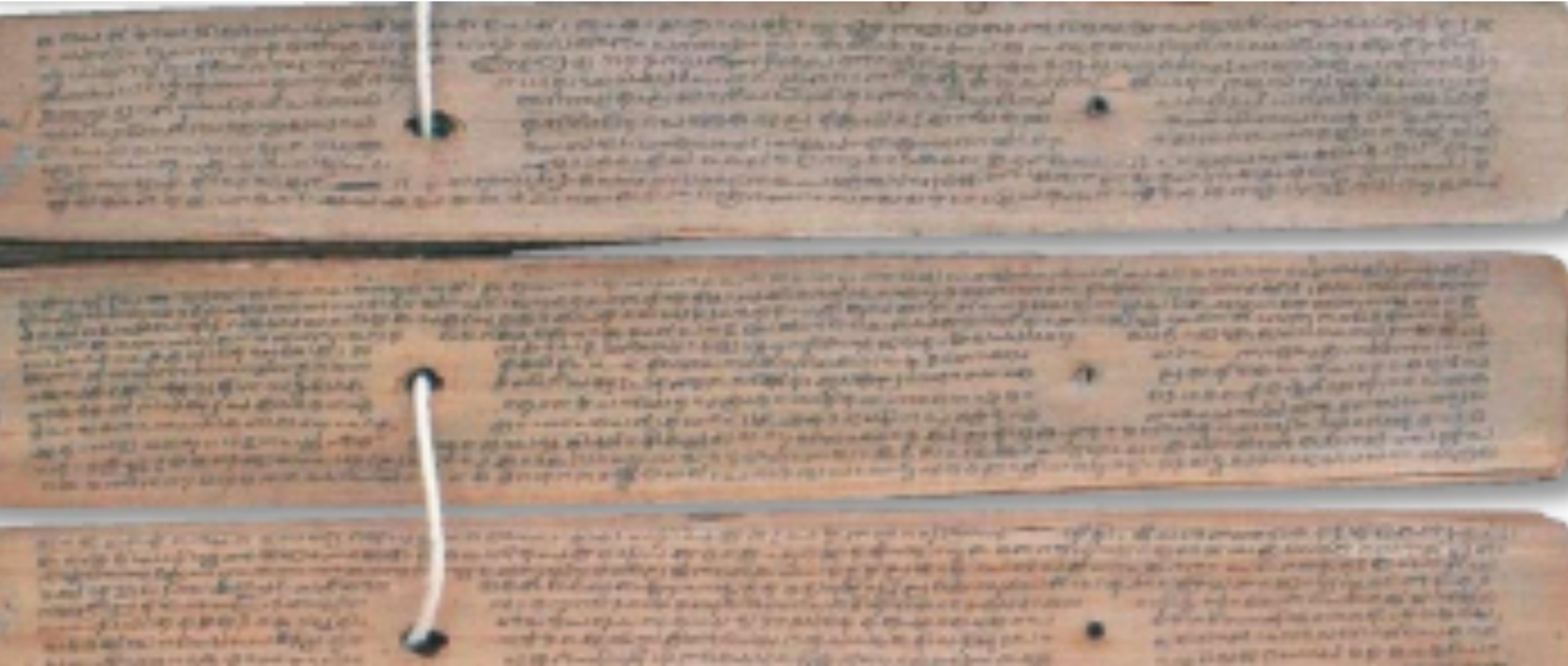
[ Rediscovered circa 16th-century Arthashastra manuscript in Grantha script, from the Oriental Research Institute (ORI), Mysuru. Found in 1905. Image via Wikimedia Commons, public domain. ]
The goal of all such measures is the augmentation of state power, often at the expense of rivals. Unlike tianxia, which depends on virtue and collective consent, suggesting that moral authority draws others inward; the mandala depends on vigilance and adaptation, assuming that alliances shift with circumstance rather than principle. For this reason, the Arthashastra is frequently recognised as the earliest systematic expression of political realism. In Chanakya’s view, the ruler’s task is to wield every element of national power to secure a lasting and advantageous position for the state.
Book Seven of the Arthashastra develops the previously mentioned mandala theory, or the “circle of states,” a model that conceptualises interstate relations as a dynamic network of neighbouring kingdoms,
each defined by its proximity, interests, and power. The mandala is described as comprising twelve kings or states, though this number functions primarily as an analytical construct rather than a fixed enumeration. At first the model appears excessively complex, since each state contains six constituent elements including the ruler, ministers, territory, fortifications, treasury, and army, producing a total of seventy-two variables to be assessed within the system as a whole. When examined in detail, however, the underlying logic is remarkably clear and consistent. The theory rests upon a geopolitical axiom that neighbouring states are naturally predisposed to rivalry, while those separated by a common adversary tend toward alliance, portraying an ever-shifting equilibrium of hostility and cooperation in which rulers continually seek to augment their influence and secure preeminence within an unstable constellation of powers.
For Chanakya, these relations were governed solely by pragmatism. A ruler’s actions should always reflect his relative strength. When weaker than an opponent he should seek peace; when stronger he should wage war; when equal he should remain neutral; when far stronger he should advance; and when powerless he should seek protection. Yet it is notable that despite his austere ruthlessness, he placed in the Mauryan raison d’etat rājadharma (the ruler’s duties) and yogakshema (welfare/security of subjects), rejecting aggrandisement as an end in itself.
Though over two millennia have passed since Chanakya outlined these principles, many of these ideas continue to apply to India today. The concept of the mandala still exists, though refracted through the modern system and its goal of diplomacy rather than conquest. Naturally, India’s priorities have evolved considerably since the age of the Mauryan emperors. No longer driven by the expansionist imperatives of a territorial empire, it now seeks more subtle influence through soft power, regional partnerships, and multilateral engagement. Its objectives centre on preserving strategic autonomy while projecting cultural and moral authority across South Asia and beyond.
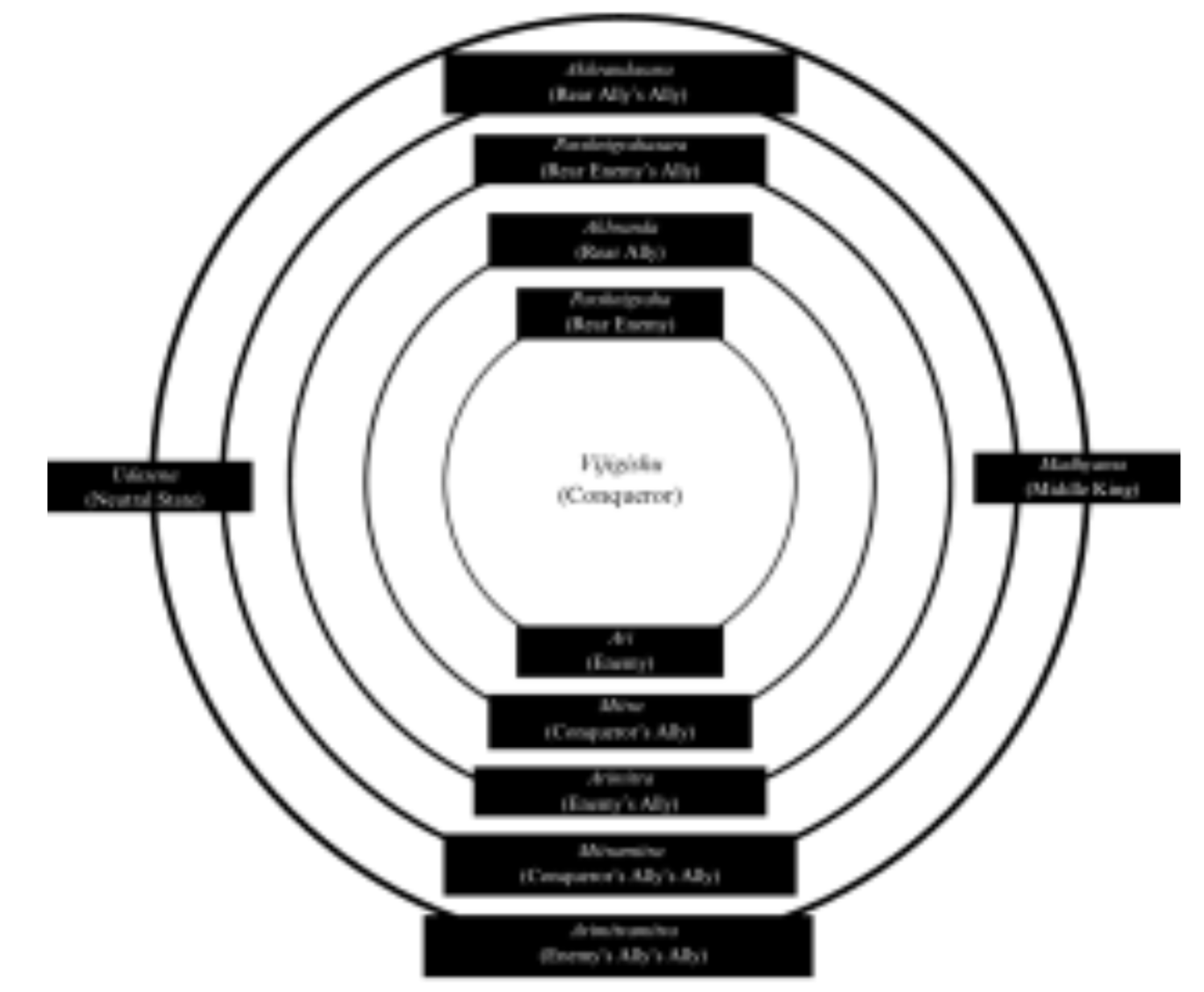
[ The Mandala Theory of Inter-State Relations, illustrating concentric alliances and rivalries. Adapted from Dr. Rajeev (2011), “Inter-State Relations in Kautilyan Arthasastra,” Journal of Advances and Scholarly Researches in Allied Education, Vol. II, Issue II. ]
Aishi Banerjee notes that the Mandala’s central premise—that neighbouring states are natural rivals while those separated by distance or by a common adversary tend toward amity—remains vividly apparent in India’s contemporary foreign relations. Since independence, India’s most volatile relations have been those
it has with its immediate neighbours China and Pakistan. The wars with Pakistan in 1965, 1971, and 1999, as well as the conflicts and border skirmishes with China in 1962 and 2020, all reveal a familiar pattern of rivalry between contiguous powers competing for security and influence. An exception can be found in Bangladesh, whose relationship with India, despite periodic disputes over migration and water sharing, has remained largely collaborative, challenging the mandala’s deterministic approach.
Interestingly, Saravanan Rathakrishnan states that this dynamic also extends into India’s trade and economic policy. By attempting to deepen economic ties with its immediate neighbours, India raises the costs of confrontation and reduces the likelihood of open conflict, while simultaneously strengthening its relations with the “neighbours of its neighbours” to balance the influence of its natural adversaries. However, this interpretation may risk overstating the stabilising power of economic interdependence. Trade has not necessarily translated into trust, and material links alone have proven insufficient to overcome the historical and ideological rifts that define South Asia’s politics.
Conversely, Banerjee adds that the mandala’s corollary principle—that the “neighbour’s neighbour” is a natural ally—illuminates aspects of India’s enduring partnerships with Russia and Iran. The Indo-Soviet Treaty of Peace, Friendship and Cooperation of 1971 and continuing defence cooperation are a prime example of sustained alignment that has outlasted Cold War contingencies. Likewise, India’s strategic collaboration with Iran, particularly through the development of the Chabahar Port, reflects an effort to bypass Pakistan and balance China’s influence in the Indian Ocean region. She further notes that India’s relations with smaller Himalayan neighbours such as Nepal and Bhutan demonstrate the mandala’s capacity to account for neutrality and mediation. These states function as the udasena of the classical mandala, acting as buffers between larger rivals while maintaining cooperative ties with both. Nonetheless, to rely on the mandala as the sole geopolitical model for South Asia in the present day is overly reductionist.
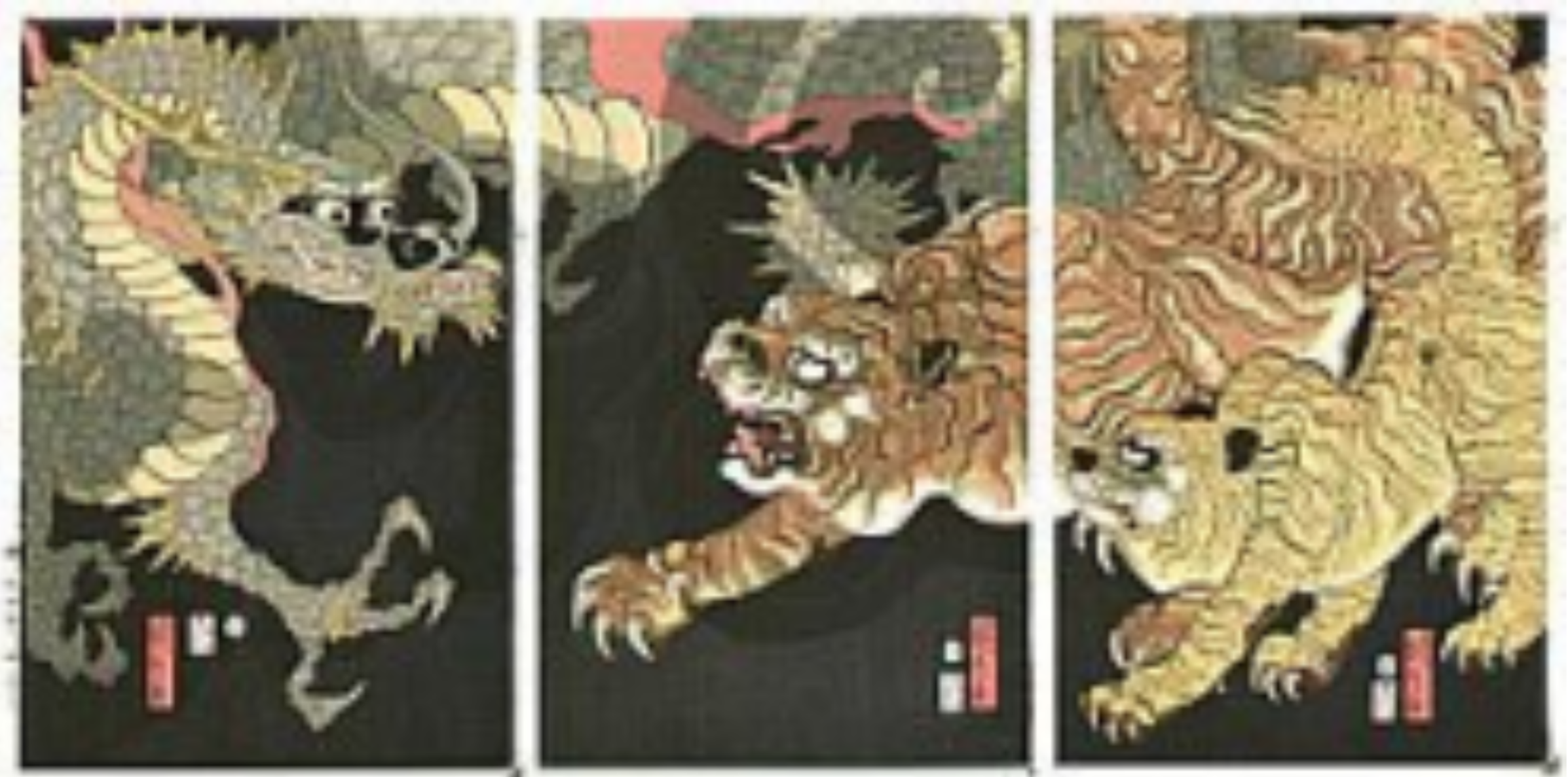
[ A late Edo era woodblock print titled ‘A Dragon and Two Tigers’ by Utagawa Sadahide. Image via Wikimedia Commons, public domain. ]
Although tianxia and mandala emerged from distinct cultural and historical milieus, both Asiatic visions of order seek to explain how power emanates from a centre and organises the world beyond it. Each, however, arises from a different kind of failure. Tianxia, at its most aspirational form, addresses the absence of a shared telos of global civilisation by proposing a universal ethic directed toward collective well-being. It does, however, function more as a moral compass than as a practical system and carries an inherent tendency toward Sinocentrism, which makes it less attractive to other sovereign nations that resist subsuming their political identities within a hierarchical order. The mandala, by contrast, acknowledges the limits of power and the inevitability of conflict, suggesting that stability is achieved through the careful management of interests among unequal states. Its strength lies in its capacity to absorb recurrent contestation and periodic shifts in alignment. Yet it is sustained by self-interest. The pursuit of order remains inseparable from the pursuit of advantage, a view difficult to reconcile with more idealist conceptions of international order. The same dynamism that grants it resilience ensures chronic volatility.
Like most other ideas, tianxia and mandala are living ideas that are continually reshaped by the changing exigencies of each age. Their longevity attests to their capacity to evolve while preserving their normative cores. From both, one may draw a modest conclusion applicable to the times we find ourselves in: ends will still require a moral horizon that many can recognise, and means will still require instruments that rivals can live with.
